

Find the lead that sticks
To identify the winning pitcher, find the lead the winning team never gives back. Then check who was pitching when that lead was taken—or whose turn as the relevant pitcher continued while his team batted. Apply the starter’s minimum-innings requirement and the brief, ineffective relief exception before assigning the win.
Under Rule 9.17(a), a pitcher generally receives the win if his team takes that lasting lead while he is in the game, or during the inning on offense in which he is removed. He does not have to throw the game’s final pitch. Read 2026 Official Baseball Rules, Rule 9.17(a).
A tie resets the winning-pitcher calculation. If a team leads 3–2, gets tied 3–3, and later goes ahead 4–3, trace the decision from the 4–3 lead if that lead holds. The earlier advantage no longer determines the win.
Trace a fictional 3–2 game
Morgan Lee starts for Mill, the home team, and pitches five innings. He allows two earned runs in the top of the fourth and no further runs through the fifth. Mill enters the bottom of the fifth trailing Harbor 2–0.
M4 walks and moves to third on M5’s double. With nobody out, M6 singles against Harbor starter Avery Bailey, driving in both runners to tie the score 2–2. M7 then doubles, sending M6 to third. Jordan Diaz replaces Bailey, and M6 scores on a sacrifice fly to right field, recorded as SF9. Mill now leads 3–2.
Lee is still Mill’s pitcher when those three runs score. Cameron Shaw enters in the top of the sixth and records all 12 remaining outs without allowing a run. Mill wins 3–2.
Why Lee gets the win
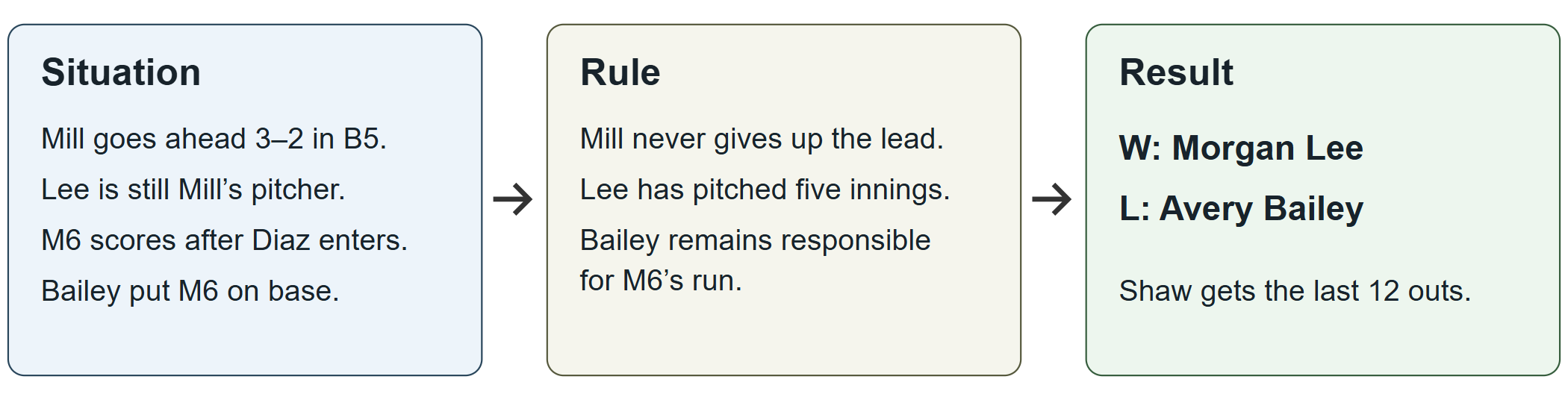
Lee completed five innings and was still Mill’s pitcher during its three-run fifth. Because Mill never relinquished the resulting lead, he receives the win. Shaw’s final four innings preserve that decision; recording the last out does not transfer the win to him. See Rules 9.17(a)–(b).
Why Bailey gets the loss
M6 scores the third run—the run that puts Mill ahead for good. Although Diaz is pitching when M6 crosses the plate, Bailey allowed M6 to reach base. M6 is an inherited runner: a runner already on base when a reliever enters. In this sequence, responsibility for that runner stays with Bailey.
Rule 9.17(d) assigns the loss to the pitcher responsible for the run that gives the winning team a lead it never relinquishes. The inherited-runner provisions of Rule 9.16(g) explain why Bailey remains responsible here. Thus, the box score shows W: Lee; L: Bailey. See Rules 9.16(g) and 9.17(d).
Check the starter threshold and relief exception
A starter must complete enough innings
The minimum depends on the game’s length on defense. A starter must complete at least five innings in a game lasting six or more defensive innings, or at least four innings in a game lasting five defensive innings. Having the lead when he leaves does not override that requirement. See Rule 9.17(b).
Consider a separate hypothetical nine-inning game: the starter leaves after 4⅔ innings with a lead that holds through the finish. He cannot receive the win. If exactly one reliever pitches, that reliever gets it. If several relievers pitch, the official scorer selects the most effective under Rule 9.17(b) and its comment, considering runs, earned runs, baserunners, and the game context of their appearances. The win does not automatically belong to the first reliever.
That hypothetical does not change Mill’s result. Lee completed five innings, so he satisfied the requirement.
A brief, ineffective relief appearance can change the winner
In another separate example, a reliever gets the last out of the top of the seventh with the score tied 2–2. His team takes a 5–2 lead in the bottom half. He returns for the eighth, allows two earned runs without recording an out, and leaves with a 5–4 lead. A succeeding reliever retires the final six batters to preserve that score.
The first reliever would ordinarily be in line for the win because his team took the lasting lead during his appearance. But if the official scorer judges his outing brief and ineffective, Rule 9.17(c) requires the win to go to the most effective succeeding reliever. In this example, that is the pitcher who finished the game.
The rule’s comment says an appearance of less than one inning in which two or more earned runs score generally should be considered brief and ineffective, but it does not require that judgment. Those numbers guide the scorer; they are not an automatic cutoff. See Rule 9.17(c) and its comment.
Read the decision in order
Start with the final score and work backward to the lead that lasted. Identify the relevant pitcher when that lead was taken, check the starter’s innings, and consider whether the brief, ineffective relief exception applies. For the loss, trace the deciding runner back to the pitcher responsible for putting him on base.
A pitching win records those scoring conditions. It does not establish which pitcher contributed the most or whether a pitching change was the best tactical choice.