
A practical guide to recording each batter, following runners around the bases, and checking the inning’s totals.
Start with a row, an inning column, and a base path
To keep score in baseball, record each plate appearance where the batter’s row meets the current inning’s column. Write how the batter reached base or made an out, then update every runner affected by that play. Number the outs as they occur, and count runs only after applying the scoring rules.
You can do this on a printed scorecard or a sheet of paper. Leave enough room in each box for a small diamond, an out number, and a few notes. A labeled sequence—Home → 1st → 2nd → 3rd → Home—works just as well as a drawn diamond.
Keep batting slots separate from defensive numbers
Write the batting order down the left side, with one row for each slot. Those row numbers tell you who bats next. Defensive numbers tell you which fielders handled the ball; they have a different job.
For example, the hitter in batting slot 6 could be the catcher, whose defensive code is 2. In the example below, H1 through H8 are fictional Harbor Lights batter labels in batting order. They are not fielding codes.
| Number | Position | Abbreviation |
|---|---|---|
| 1 | Pitcher | P |
| 2 | Catcher | C |
| 3 | First baseman | 1B |
| 4 | Second baseman | 2B |
| 5 | Third baseman | 3B |
| 6 | Shortstop | SS |
| 7 | Left fielder | LF |
| 8 | Center fielder | CF |
| 9 | Right fielder | RF |
Picture the field from home plate looking toward the outfield: left field is to your left, and right field is to your right. These numbers identify positions, not jersey numbers.
Write the result, then trace the movement
The same abbreviation can mean different things in different places. In a position listing, 1B means first baseman. Inside a batter’s scoring box, 1B commonly means a single. The first baseman’s number in a fielding sequence is 3.
- 6–3
- A groundout handled by the shortstop, who throws to the first baseman for the out.
- K
- A strikeout.
- BB
- A walk, also called a base on balls.
- 1B, 2B, HR
- A single, double, or home run.
- F8
- A fly ball caught by the center fielder.
- SF9
- A credited sacrifice fly to right field. A caught fly with fewer than two outs that allows a runner to score can qualify; an ordinary flyout with no run scoring does not.
- FC 6–4
- A fielder’s choice: the shortstop throws to the second baseman to retire another runner at second while the batter reaches first without a hit.
These are useful conventions, and scorebooks differ. Your shorthand records the play; it does not replace the official scorer’s judgment about a hit, error, fielder’s choice, or sacrifice. MLB’s scoring standards appear in Rules 9.05–9.12 of the 2026 Official Baseball Rules.
Update the runners already on base
- Enter the batter’s result. Write the code in that batter’s box for the current inning.
- Mark the batter’s path. Trace only the bases reached. For a single, draw the home-to-first segment or write “Home → 1st.”
- Return to earlier runners’ boxes. Extend their paths when they advance. Add the later batter’s label or another clear explanation, such as “to 2nd on H5 BB.”
- Number each out where it happens. Use ①, ②, and ③. If a runner is forced out, mark that runner’s box and cross-reference the batter’s play.
- Confirm runs, then total the inning. Fill a completed diamond only for a run that counts.
Touching home before the third out does not always produce a run. Under MLB Rule 5.08, no run scores on a play whose third out is a force out or the batter-runner’s out before touching first. An appeal can also affect whether a run counts. Keep a homeward path unfilled until the relevant ruling is clear. See Rule 5.08 and its exceptions.
A complete half-inning: Harbor Lights, top of the fourth
The Harbor Lights are visiting the Mill Rivets in this fictional teaching game. Begin the top of the fourth with nobody on base and no outs. All eight entries belong in the fourth-inning column, each on its batter’s row.
The grid shows each box after the half-inning is complete, so it includes advances caused by later hitters. Every base path is written out. A filled diamond, ◆, marks a credited run; the circled numbers identify the three outs.
| Batting slot and batter | Inning 4 scoring box: result and base path | Out or run mark |
|---|---|---|
| 1 — H1 |
1B Home → 1st on own single → 2nd → 3rd → Home on H2’s HR. |
◆ 1 run |
| 2 — H2 |
HR Home → 1st → 2nd → 3rd → Home on own home run. H1 also scores. |
◆ 1 run |
| 3 — H3 |
6–3 Home → out before reaching 1st. Shortstop throws to first baseman. |
① First out |
| 4 — H4 |
1B Home → 1st on own single → 2nd on H5’s BB → 3rd on H7’s 1B. Crosses Home on H8’s play before the force out, but the run does not count. Note “no run: third-out force.” |
0 runs; leave diamond unfilled |
| 5 — H5 |
BB Home → 1st on walk → 2nd on H7’s 1B. Reaches 3rd during H8’s play; the inning ends on the force at 2nd. No run scores. |
0 runs; 1 walk |
| 6 — H6 |
F8 Home → out on a fly caught in center field. H4 holds 2nd; H5 holds 1st. |
② Second out |
| 7 — H7 |
1B Home → 1st on own single, loading the bases: H4 at 3rd, H5 at 2nd, H7 at 1st. 1st → forced out at 2nd on H8’s FC 6–4. |
③ Third out at 2nd |
| 8 — H8 |
FC 6–4 Home → 1st on fielder’s choice. Shortstop throws to second baseman, forcing H7 at 2nd. No hit. Cross-reference H7’s box for out ③. |
0 runs; inning ends |
| Top-fourth totals | 4 hits · 2 runs · 3 outs · 1 walk · 8 plate appearances | |
Play-by-play text alternative: H1 singles. H2 homers, scoring H1 and H2. H3 grounds out, shortstop to first baseman, for one out. H4 singles. H5 walks, moving H4 to second. H6 flies out to center for two outs; both runners hold. H7 singles, moving H4 to third and H5 to second and loading the bases. H8 reaches on a fielder’s choice as the shortstop throws to the second baseman to force H7 at second for the third out. H4 crosses home before that out, but the force prevents the run from counting. H5 reaches third, and the force ends the inning. The half-inning produces two runs on four hits.
One earlier-box update, step by step
Immediately after H7’s single, H7’s box reads “1B; Home → 1st.” When H8 bats, return to that same box. Keep the single, extend the path toward second, and mark “③ at 2nd; H8 FC 6–4.” H7 still receives credit for the earlier hit; being forced out later does not remove it.
Now check the out tally: H3 has ①, H6 has ②, and H7 has ③. H8’s box explains the play but does not add another out. Then check the runs: only H1 and H2 have filled diamonds.
Reconcile the inning before moving on
Count the hits in H1, H2, H4, and H7’s boxes: four. Count H5’s walk separately. H8’s fielder’s choice is not a fifth hit. Eight completed batter entries give eight plate appearances. Together, the four hits, one walk, two batter outs, and one fielder’s-choice plate appearance account for all eight hitters.
Record 2 in Harbor’s fourth-inning run total. The bookkeeping is finished when the base paths, three out marks, and totals tell the same story. MLB’s required batting records distinguish measures such as at-bats, runs, hits, and walks; see Rule 9.02.
Carry the same method through the game
Start a fresh inning column for the next half-inning you are recording, while keeping each team’s batting order intact. If you keep both teams, use a separate grid for each. The accompanying printable scorecard includes the top of the fourth and bottom of the fifth; the complete fourth-inning grid above can also be copied onto blank paper.
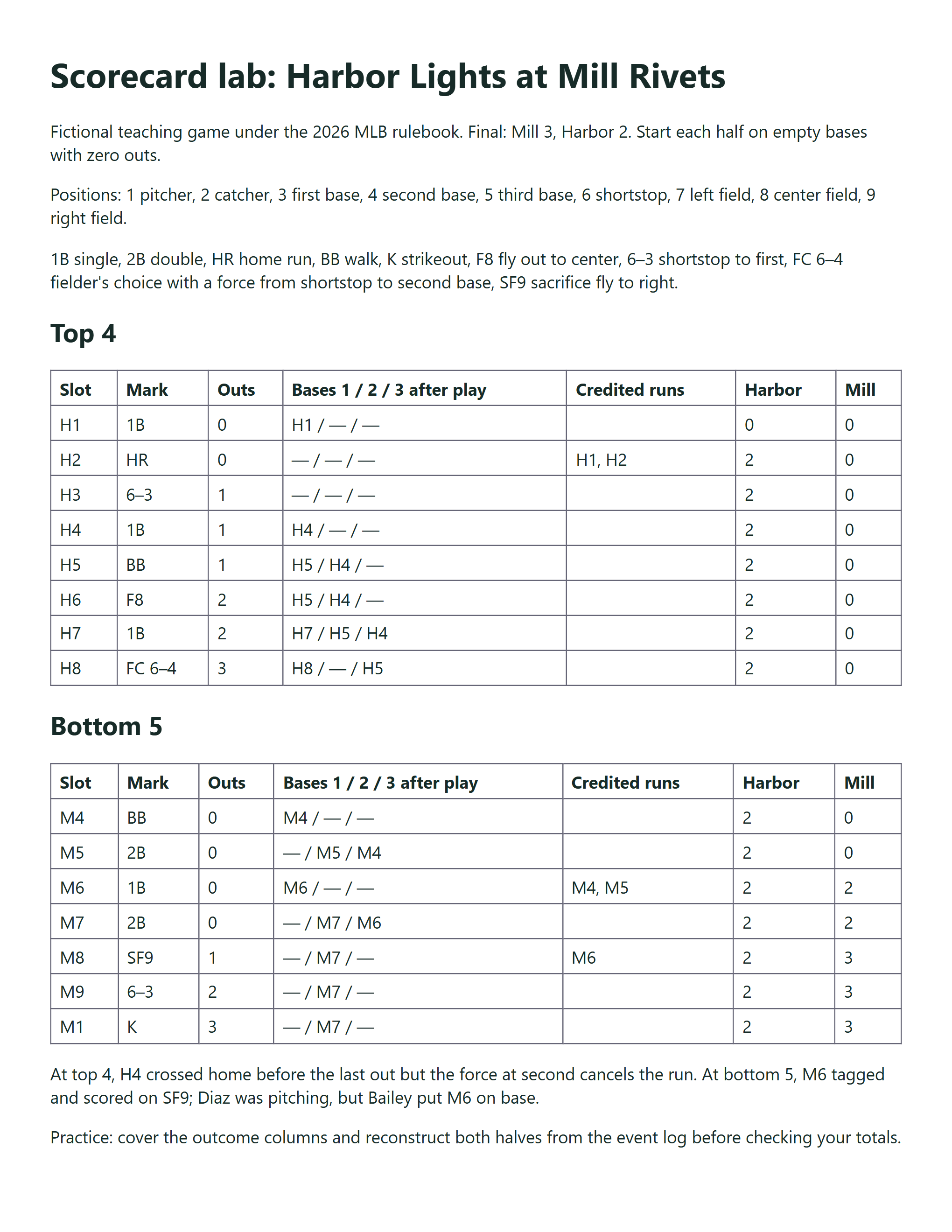
Scorecard lab: Harbor Lights at Mill Rivets
Fictional teaching game under the 2026 MLB rulebook. Final: Mill 3, Harbor 2. Start each half on empty bases with zero outs.
Positions: 1 pitcher, 2 catcher, 3 first base, 4 second base, 5 third base, 6 shortstop, 7 left field, 8 center field, 9 right field.
1B single, 2B double, HR home run, BB walk, K strikeout, F8 fly out to center, 6–3 shortstop to first,
FC 6–4 fielder’s choice with a force from shortstop to second base, SF9 sacrifice fly to right.
Top 4
| Slot | Mark | Outs | Bases 1 / 2 / 3 after play | Credited runs | Harbor | Mill |
|---|---|---|---|---|---|---|
| H1 | 1B | 0 | H1 / — / — | 0 | 0 | |
| H2 | HR | 0 | — / — / — | H1, H2 | 2 | 0 |
| H3 | 6–3 | 1 | — / — / — | 2 | 0 | |
| H4 | 1B | 1 | H4 / — / — | 2 | 0 | |
| H5 | BB | 1 | H5 / H4 / — | 2 | 0 | |
| H6 | F8 | 2 | H5 / H4 / — | 2 | 0 | |
| H7 | 1B | 2 | H7 / H5 / H4 | 2 | 0 | |
| H8 | FC 6–4 | 3 | H8 / — / H5 | 2 | 0 |
Bottom 5
| Slot | Mark | Outs | Bases 1 / 2 / 3 after play | Credited runs | Harbor | Mill |
|---|---|---|---|---|---|---|
| M4 | BB | 0 | M4 / — / — | 2 | 0 | |
| M5 | 2B | 0 | — / M5 / M4 | 2 | 0 | |
| M6 | 1B | 0 | M6 / — / — | M4, M5 | 2 | 2 |
| M7 | 2B | 0 | — / M7 / M6 | 2 | 2 | |
| M8 | SF9 | 1 | — / M7 / — | M6 | 2 | 3 |
| M9 | 6–3 | 2 | — / M7 / — | 2 | 3 | |
| M1 | K | 3 | — / M7 / — | 2 | 3 |
At top 4, H4 crossed home before the last out but the force at second cancels the run.
At bottom 5, M6 tagged and scored on SF9; Diaz was pitching, but Bailey put M6 on base.
Practice: cover the outcome columns and reconstruct both halves from the event log before checking your totals.
This fictional game ends Mill Rivets 3, Harbor Lights 2. Mill is the home team and is ahead after the top of the ninth, so there is no bottom of the ninth to record. Mark that unused half-inning with a dash or an X according to your convention, rather than entering a zero that would suggest it was played.
If the fielding numbers still take a moment to recognize, Baseball Positions: Nine Defensive Roles with Diagram provides useful context. Once the boxes are complete, Baseball Statistics Explained: Key Measures and Examples connects those entries to the totals they produce.
The rule references here use the 2026 MLB rules. The Harbor Lights–Mill Rivets episode, grid, and shorthand are independent teaching material, not real team data or a universal scoring system. For the governing MLB text, consult the official rules index.