
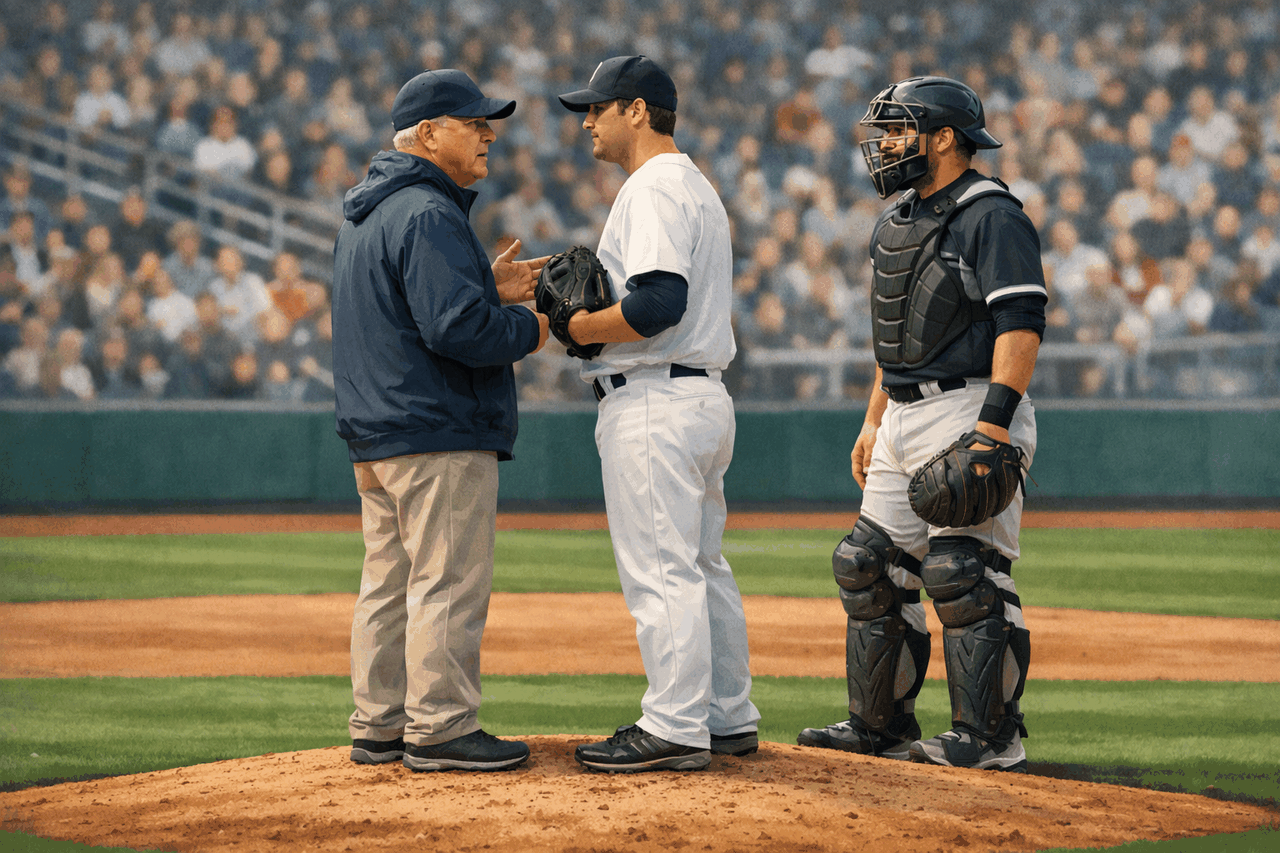
Check the team’s visits, then the pitcher’s situation
Whether someone can visit the mound and whether a pitcher can leave are separate questions. MLB uses three rules: a team allowance for mound visits without a pitching change, a removal requirement triggered by a second coach or manager trip to the same pitcher in an inning, and a three-batter minimum that controls when a pitcher may be replaced.
For 2026, each team gets four mound visits without a pitching change per nine innings. That allowance belongs to the team, not to each pitcher. Each extra inning provides one additional non-change visit for that inning; an unused additional visit does not carry over. A visit that results in a pitching change does not spend the non-change allowance. These limits appear in Official Baseball Rules, Rule 5.10(m).
A visit does not require a manager or pitching coach. A position player who relocates to confer with the pitcher generally uses a team visit, too. Brief, normal conversation between batters without either player relocating and a visit to check a potential injury are examples of exceptions. After the allowance is exhausted, an umpire may also permit a brief catcher visit to resolve crossed signals. That exception requires the umpire’s discretion; it does not replenish the team’s visits. See MLB’s mound-visit explanation.
A second coach trip is a separate limit
A second coach or manager trip to the same pitcher in the same inning triggers the pitcher’s removal under Rule 5.10(l). Having unused team visits does not cancel that requirement. A position player’s visit generally affects the team allowance, but it is not itself a coach or manager trip.
Check the batter, too. Under Rule 5.10(l), the coach may not make a second visit while the same batter is still at bat. If a pinch hitter replaces that batter, the rule permits a second visit with removal of the pitcher, subject to the applicable minimum.
For the ninth inning, MLB’s operational overview describes one extra visit when the defensive team ends the eighth with none left.
Think of two separate records: how many non-change visits the team has used, and whether a coach or manager has already visited this pitcher during this inning. Neither record tells you, by itself, whether the pitcher has satisfied the minimum needed to leave.
Count completed batters before a change
A starting or replacement pitcher ordinarily must finish facing three consecutive batters, or remain until the inning ends, before being replaced. Count completed plate appearances, not pitches or conversations at the mound. An intentional walk counts as a completed plate appearance. A pickoff does not count as a batter faced, although a pickoff that produces the third out ends the inning and opens an opportunity to change pitchers. The governing provision is Rule 5.10(g)(1); MLB also provides a three-batter minimum overview.
Ending the inning creates an opportunity to remove the pitcher; it does not erase an unfinished requirement if he returns. A pitcher who completes two plate appearances, finishes the inning, and comes back for the next inning still owes one completed plate appearance before an ordinary substitution, unless that inning ends first.
The rule includes an exception for an injury or illness that, in the umpire’s judgment, incapacitates the pitcher from continuing. An ordinary request for a different pitcher does not qualify.
What happens when the team has no visits left?
If a coach or manager crosses the foul line for a non-exempt mound visit after the team exhausts its allowance, a pitching change is required. But an unfinished three-batter minimum can delay that change: the pitcher continues until he completes the applicable requirement or the inning ends, then is removed. An unauthorized position-player visit after the allowance is exhausted does not itself require the pitcher’s removal. Those different consequences are addressed in Rule 5.10(m).
A quick decision guide
| Situation | Ruling |
|---|---|
| Team has a visit left; first coach or manager trip to this pitcher this inning; pitcher stays | Generally allowed. Charge one non-change team visit. |
| Second coach or manager trip to the same pitcher this inning; different batter up and minimum satisfied | The pitcher must be removed, even with team visits remaining. |
| No team visits left; non-exempt coach or manager visit; minimum satisfied | A pitching change is required. |
| No team visits left; non-exempt coach or manager visit; minimum unfinished and inning continues | The pitcher must continue until the minimum is satisfied or the inning ends, then be removed. |
| No team visits left; unauthorized position-player visit | The visit does not itself force removal. |
| Inning ends before the pitcher completes three plate appearances | Replacement is allowed between innings. Returning for the next inning carries the unfinished requirement forward. |
Three fictional calls, explained
The following situations are teaching examples.
Visits left, but the pitcher must leave. The starter has completed four plate appearances in the inning. The first trip was during an earlier plate appearance. With a different batter up, his manager makes a second trip, and the team still has two non-change visits available. Allowed: replacing the pitcher. Not allowed: keeping him in simply because the team has visits left. The same-pitcher trip rule controls.
No visits left, but the pitcher must stay temporarily. A reliever has completed two plate appearances when a coach crosses the foul line for a non-exempt visit with the team’s allowance exhausted. Allowed: the pitcher continues until the requirement is met or the inning ends, then leaves. Not allowed: an immediate ordinary substitution. If the next batter receives an intentional walk, that completes the third plate appearance and permits the required change.
A pickoff ends the inning without counting as a batter. A reliever enters with two outs and a runner on first, then picks off the runner before completing any plate appearance. Allowed: replacing him before the next inning. Not allowed: counting the pickoff as a completed plate appearance or treating his minimum as permanently satisfied. If he returns, he still owes three completed plate appearances unless the inning ends first.
Once a change is permitted, see the separate procedure in MLB Pitching Changes: When a Pitcher May Be Replaced.