

Start with the pitcher’s own four-seam fastball
To identify a baseball pitch, compare it with that pitcher’s four-seam fastball. Look for a change in sideways movement, downward movement or timing. A sinker typically shows more drop, more movement toward the pitcher’s throwing-arm side, or both; a cutter moves toward the glove side; breaking balls create more pronounced sideways or downward separation. Changeups and splitters can initially resemble a fastball while disrupting the hitter’s timing and expected path.
The useful reference is the pitcher’s own fastball. Two pitchers can throw pitches with the same name that look noticeably different. Start by learning what one pitcher’s ordinary four-seamer looks like, then watch how the other pitches depart from it.
A four-seamer’s apparent “rise” usually means less drop, rather than upward flight. Backspin helps oppose gravity, so a fastball with substantial “ride” can stay above the path a hitter anticipates while still generally descending toward the plate. See MLB’s explanation of the four-seam fastball.
Keep two questions separate: What did the ball do? and What was the pitcher trying to accomplish? Movement helps describe the pitch; its use explains why the pitcher might choose it. Neither tells you exactly how the pitcher held the ball.
How eight common pitch types compare
The comparisons below describe typical tendencies for a right-handed pitcher, using that pitcher’s four-seamer as the reference. Individual pitches can overlap. MLB’s pitch-type glossary provides the official names and family groupings; the purposes here describe common tactical aims, not promised results.
| Pitch | Family | Typical movement compared with the four-seam | Common purpose | Where appearances overlap |
|---|---|---|---|---|
| Four-seam fastball | Fastball | The reference pitch: often relatively direct-looking, with less drop than the pitcher’s other offerings. It may also have some arm-side movement. | Challenge the hitter’s timing and establish the fastball look that other pitches can resemble. | A four-seamer with substantial arm-side run can resemble a sinker. |
| Sinker | Fastball | More drop, more arm-side run, or both. Arm-side run is toward catcher-left for a right-hander. | Seek ground-ball contact and move the ball away from the hitter’s expected barrel path. | Sinker and two-seam labels can overlap; some running four-seamers can look similar. |
| Cutter | Fastball | A relatively small glove-side departure from the four-seam’s path. | Preserve a fastball-like appearance while changing where the ball meets the bat. | A cutter with more break can resemble a firm slider. |
| Slider | Breaking ball | Glove-side break with a downward component; the balance varies considerably. | Draw a swing that follows the initial fastball look but misses the eventual path. | Tighter versions can resemble cutters; wider versions can resemble sweepers. |
| Sweeper | Breaking ball | Emphasizes broad glove-side movement, typically more sideways than a conventional, firmer slider. | Create horizontal separation from the hitter’s expected contact path. | The boundary with a slider varies by pitcher; a sweeper can also have downward movement. |
| Curveball | Breaking ball | Pronounced downward break, sometimes accompanied by glove-side movement. | Change the hitter’s visual expectation and disrupt timing. | A slider with substantial downward break can resemble a curveball. |
| Changeup | Offspeed | Often more drop and arm-side fade, though some versions have little sideways movement. | Disrupt timing while initially suggesting a fastball. | Arm-side movement can resemble a sinker; downward action can resemble a splitter. |
| Splitter | Split-finger fastball; commonly used in an offspeed role | A downward departure from the expected fastball path, with varying sideways movement. | Invite a fastball-timed swing as the ball drops below the anticipated contact path. | Some splitters and downward-moving changeups are difficult to separate by appearance alone. |
A movement map from behind home plate
Imagine looking from behind home plate toward a right-handed pitcher. Catcher-left is the pitcher’s arm side; catcher-right is the glove side. For a left-hander, mirror the horizontal directions. Keep the downward direction the same.
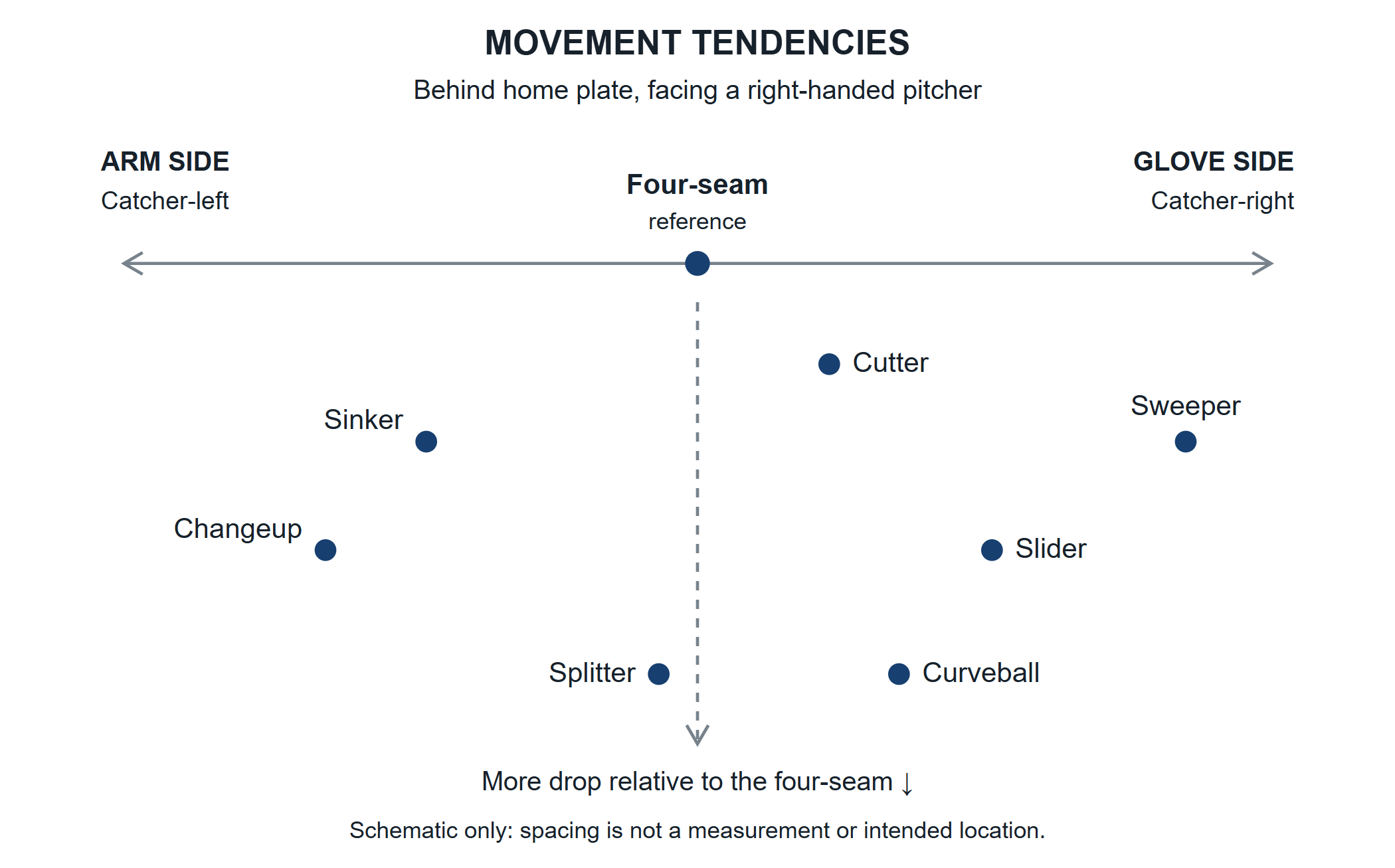
Text alternative: Relative to a right-hander’s four-seam, sinkers and many changeups tend toward arm-side movement and more drop. Cutters move toward the glove side; sliders combine glove-side and downward break; sweepers emphasize sideways break. Splitters emphasize drop, while curveballs emphasize downward break and may also move glove-side. Individual shapes overlap, and the diagram does not establish a fixed ranking of how far each pitch moves.
This is a map of movement tendencies, not a strike-zone diagram, target or traced flight. A center-field television camera looks in the opposite direction, so its screen-left and screen-right do not directly match this view.
Classify what you saw without forcing a label
- Find the reference. Use a clearly identified four-seamer from the same pitcher to establish the familiar fastball path.
- Compare sideways movement and drop. Did the pitch move farther arm-side, farther glove-side or mainly downward? Consider those differences together.
- Consider the intended effect. A fastball-like pitch that disrupts timing suggests a different role from a breaking ball that creates broad sideways separation. The hitter’s reaction is a clue, not proof.
- Leave room for overlap. A replay may support “glove-side breaking ball” more confidently than “slider” or “sweeper.” A broadcast or tracking label can supply the more specific classification.
Pitch names describe categories with fuzzy edges. A cutter can approach a slider’s shape, and a slider can approach a sweeper’s. MLB’s 2025 account of expanding pitch arsenals provides historical context for those increasingly detailed MLB and Statcast classifications. A separate label can identify a useful distinction within one pitcher’s repertoire even when another pitcher’s offerings overlap it.
Leo Rivas’s walk-off: what the label establishes
MLB’s regular-season account of Leo Rivas’s walk-off single identifies Ryan Zeferjahn’s pitch on the decisive hit as a sweeper. That is a real pitch label attached to the play.
For a viewer, the useful next step is to connect that name with its typical sideways-breaking character. MLB’s sweeper explanation describes that emphasis while allowing for variation. The name alone does not establish the exact horizontal break, drop or difference from Zeferjahn’s four-seamer on that delivery.
The single tells you the result of the plate appearance. It does not prove how much the pitch moved or whether its shape matched the pitcher’s intention. Classification, movement and outcome answer different questions.
Movement explains the pitch; a grip explains how it is held
Recognizing a sinker or sweeper is a viewing skill. Reproducing one involves separate questions about grip, release and individual mechanics. A movement diagram cannot serve as a grip diagram, and the pitch name alone does not prescribe a hand position.
For grip diagrams and safety boundaries, continue with Pitching Grips Explained: Grip Diagrams and Safety Boundaries.