
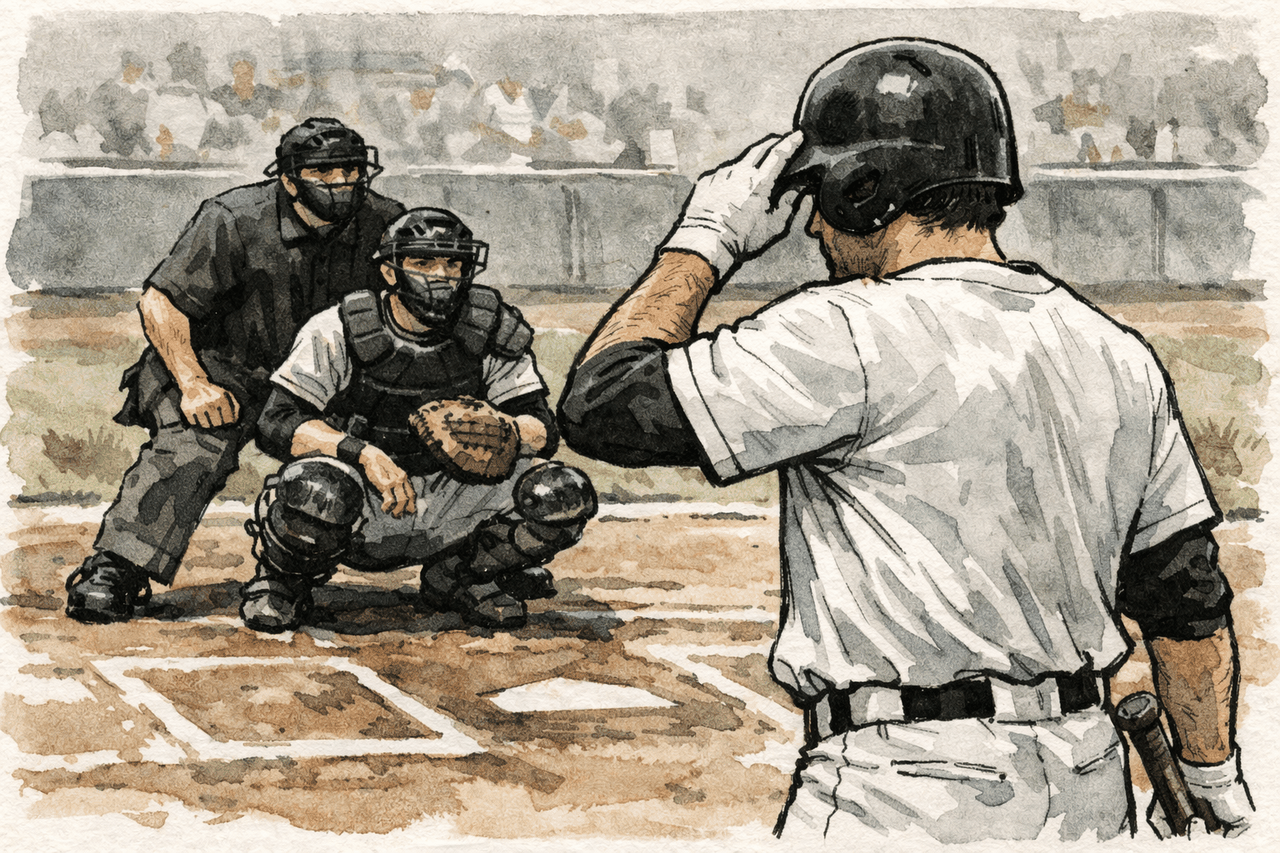
A cap or helmet tap can change the count in MLB in 2026 if an eligible player immediately challenges a called ball or strike and the automated ball-strike system, or ABS, overturns the umpire’s call. The home-plate umpire calls the pitch first. Technology decides the challenged call.
Who can tap—and when?
Only the batter, pitcher or catcher involved in that pitch can request an ABS challenge. A manager cannot request one, and the player cannot get help from the dugout or teammates before deciding. Those limits are part of MLB’s explanation of the 2026 challenge system.
The player signals by tapping their cap or helmet immediately, generally within about two seconds of the call or, where applicable, after the resulting play ends. That allowance matters when a pitch leads to action: the challenge procedure accounts for the play finishing. The umpire can deny a late request or one made with assistance without charging the team a challenge, according to MLB’s operational FAQ.
The appeal concerns whether a called pitch was a ball or strike. It cannot settle whether a batter checked their swing, and pitches thrown by position players cannot be challenged. An ABS challenge also cannot follow a replay review. Those eligibility limits apply even when a team still has challenges available.
One called ball, two possible counts
Suppose the count is 1–1 and the umpire calls the next pitch a ball. The count becomes 2–1. The pitcher or catcher believes it caught the ABS strike zone and immediately requests a challenge. Here is how that example works.
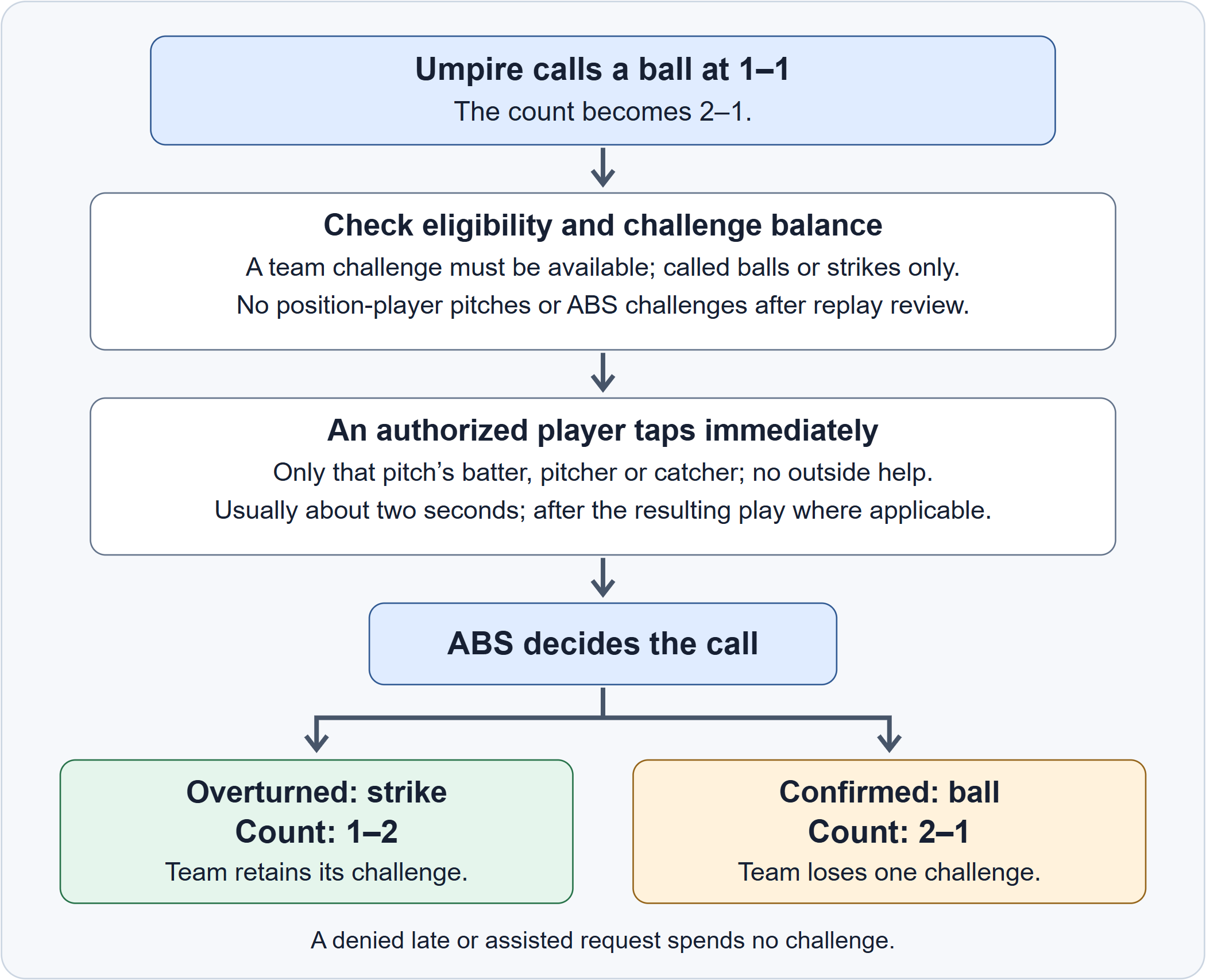
Text alternative: A called ball at 1–1 makes the count 2–1. With a challenge available and the pitch eligible, an immediate, unassisted request from that pitch’s batter, pitcher or catcher sends the call to ABS. An overturned ball becomes a strike: the count changes to 1–2, and the team keeps its challenge. A confirmed ball leaves the count at 2–1 and costs the team one challenge. Check swings, position-player pitches and ABS requests following replay review are excluded.
The count changes because the original call changes. The challenge itself adds no ball or strike. For a challenged called strike, the same principle works in reverse: an overturn replaces that strike with a ball. MLB’s operating rules tie the challenge balance to whether the original call is confirmed or overturned.
Two to start, with a specific extra-inning refill
Each team starts the game with two ABS challenges. A confirmed call costs one; an overturned call lets the team retain it. At the start of each extra inning, a team receives one additional challenge only if it enters that inning with zero, under MLB’s 2026 allocation rules.
Follow a team that reaches the 10th with none left:
- Start of the 10th: Its balance rises from zero to one.
- If a call is confirmed during the 10th: That challenge is spent. If the game reaches the 11th with the team still at zero, it receives one at the start of the 11th.
- If a call is overturned during the 10th: The team keeps its challenge. Entering the 11th with one means it receives no additional challenge.
ABS challenges have their own balance, separate from a manager’s replay-review allotment. A replay review may follow an ABS challenge through a separate procedure, but an ABS challenge cannot follow a replay review. The two processes therefore cannot be used interchangeably.
Where the 2026 system applies
For 2026, ABS challenges are used at MLB ballparks, and MLB’s postseason FAQ confirms their use in the playoffs. The 2026 operational FAQ documents exceptions for the Mexico City Series, the Field of Dreams game and the Little League Classic.
For a viewer watching an eligible game, the sequence is straightforward: hear the umpire’s call, watch for an immediate player tap, then check both the resulting count and the team’s remaining challenges.