
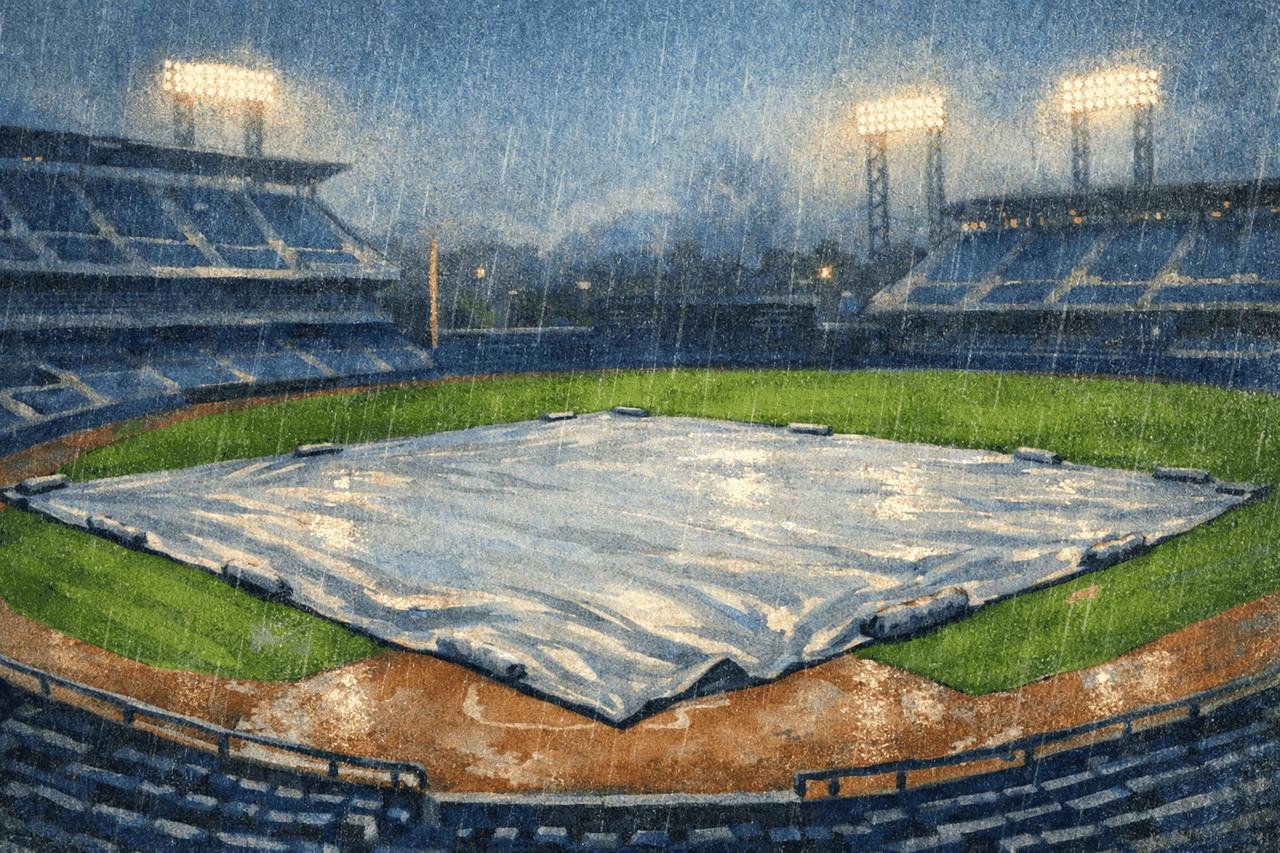
The quick answer: a delay pauses play; a call requires a ruling
A rain delay pauses play with the possibility of restarting later that day. A postponement before the first pitch means the game has not begun. Once a game underway is called because play cannot continue, the next step depends on the inning, the score, and MLB’s 2026 rules. Five innings alone do not make every rain-shortened score final.
For viewers, the useful distinction is between ending today’s play and establishing the game’s result. A called game may have a final score, or it may need to continue as a suspended game. Apply Rules 7.01(c)–(d) and 7.02 of the 2026 Official Baseball Rules to the situation at the stoppage.
When has a called game reached regulation status?
Under Rule 7.01(d), a called game is a regulation game when any of these conditions applies:
- Five full innings have been completed.
- The visitors have completed their fifth inning and the home team is already ahead.
- The home team ties the score during its half of the fifth inning.
That last condition shows why “regulation” and “final” require separate checks. A home team can tie the game in the bottom of the fifth, making it regulation, yet a call with the score tied produces a suspended game. The regulation threshold does not resolve the tie. See Rules 7.01(d) and 7.02.
A call before regulation status also does not automatically erase the innings already played. Under the 2026 resumption framework, Rule 7.02(a) provides for arranging resumption and completion, subject to the rule’s later exceptions and fallback provisions.
A decision table for the scoreboard you are watching
The situations below are hypothetical regular-season examples. They show why the inning boundary and the home team’s opportunity to respond matter alongside the number of innings played. The governing provisions are Rules 7.01(c)–(d) and 7.02(a)–(h).
| Situation | Example or deciding detail | What it means |
|---|---|---|
| Rain delay | Play is paused; the game has not been called. | A same-day restart remains possible. The delay itself establishes no final result. |
| Postponement before play | No first pitch has been thrown. | The game has yet to begin; there is no played inning or plate appearance to resume. |
| Called before regulation status | Four full innings are complete, with the home team ahead 2–1. | Apply Rule 7.02(a) to arrange resumption and completion. Do not automatically discard the four innings. |
| Called with a tied regulation score | Five full innings are complete, tied 2–2. | The game is suspended. |
| Called after the visitors take the lead in an unfinished inning | The visitors lead 4–3 after the top of the sixth; the home team has not begun its sixth. | The game is suspended. The home team has had no opportunity to answer that lead. |
| Called after a completed inning with an untied regulation score | Six full innings are complete, with the home team ahead 3–1. | The 3–1 result is final, assuming no special Commissioner determination under Rule 7.02. |
The table in words: A delay leaves open a restart that day. A postponement before play means the game has not started. Once play is called, check regulation status, whether the score is tied, and what happened in any unfinished inning. A non-regulation call enters the resumption framework; a tied regulation game is suspended. In the sixth-inning examples, a new visiting lead awaiting the home team’s turn produces suspension, while a completed sixth with the home team ahead 3–1 produces a final result under the stated conditions.
The boundary example: rain between the halves of the sixth
Suppose five full innings are complete and the home team leads 3–1. The visitors then score three runs in the top of the sixth, moving ahead 4–3. Rain arrives after the third out, before the home team takes a pitch in the bottom half. Play is eventually called.
The game has reached regulation status, but the visitors took the lead in an inning the home team has not yet completed. In this example, the home team has not even begun its response. The game is suspended under Rule 7.02’s unfinished-inning provisions. The visitors’ three sixth-inning runs remain part of the game.
When resumed, the home team comes to bat in the bottom of the sixth, trailing 4–3, with no outs and the bases empty. Rule 7.02(h) makes the resumed game a continuation from the point of suspension. If a different game stops during a plate appearance, its count, outs, and runners carry forward as applicable. See Rule 7.02(h).
Now change the sixth inning: neither team scores, both halves are completed, and the home team still leads 3–1 when rain ends play. With six full innings complete and no special Commissioner determination, the called game finishes as a 3–1 home win.
These examples establish a clear boundary. Other unfinished-inning situations—including a visiting team newly tying the score or a home team beginning its response—require the precise conditions in Rule 7.02. Keep track of the score entering the inning, the visitors’ scoring, and how far the home half progressed.
Suspension does not guarantee a completion date
Rule 7.02 provides the framework for arranging resumption and completion. If the exceptional rescheduling situation covered by Rule 7.02(c) arises, the Office of the Commissioner decides whether and when to resume after considering the relevant circumstances, including whether an unfinished game would materially affect the postseason. The fallback-result provisions in Rules 7.02(d) and (e) then govern the applicable disposition. A suspension announcement alone therefore does not guarantee a completion date or settle every eventual outcome. See Rule 7.02(c)–(e).
Keep the season context in view, too. Postseason games have separate authority under Rule 7.02(g); these regular-season examples should not be applied automatically to postseason play.
Older explanations can also cause confusion. MLB’s suspended-game glossary explains the term and includes historical discussion of the 2020 season. For a 2026 ruling—especially whether an early called game continues—use the current rulebook rather than treating that historical discussion as the governing rule.