A practical 2026 equipment check for players, parents and coaches playing under NFHS rules.
What makes a bat legal in 2026?
For a 2026 high school baseball game governed by NFHS rules, a nonwood or multi-piece wood bat needs a permanent BBCOR .50 certification mark, compliant dimensions and weight, the required grip, and an eligible model in sound condition. A USABat mark alone does not satisfy the BBCOR requirement. Solid, single-piece wood bats follow separate criteria and do not need a BBCOR stamp.
The national framework comes from Rules 1-3-2 and 1-3-3 in the 2026 NFHS Baseball Rules, available in this league-hosted PDF mirror. Consult the official NFHS baseball rules page for rule updates and dated BBCOR notices. Your state association and the specific competition’s instructions also belong in the check.
Start with the bat’s construction
A bat’s wood appearance does not establish which rule applies. Identify whether it is made from one solid piece of wood or uses another construction, such as metal, composite material or multiple pieces of wood.
Nonwood and multi-piece wood bats
Under NFHS Rule 1-3-2, check these requirements together:
- Length: no more than 36 inches.
- Barrel diameter: no more than 2⅝ inches.
- Weight: the weight in ounces must be at least the length in inches minus three. A 33-inch bat must therefore weigh at least 30 ounces.
- Grip: the required safety grip must extend at least 10 inches and no more than 18 inches from the knob.
- Certification mark: a rectangular BBCOR .50 mark must appear on the barrel in a contrasting color, with each side measuring at least 1 inch. It must be applied permanently by silkscreen or an equivalent method; a removable sticker does not qualify.
“Drop” is shorthand for the numerical difference between a bat’s weight in ounces and its length in inches. A 33-inch, 30-ounce bat is drop −3. Certification and drop answer different questions: satisfying one does not establish compliance with the other.
Solid, single-piece wood bats
Rule 1-3-3 gives single-piece wood bats their own limits: no more than 36 inches long and no more than 2¾ inches in diameter at the thickest part. Tape or other foreign substances may extend no farther than 18 inches from the handle end. These bats do not require a BBCOR stamp. Apply their own rule criteria rather than carrying the nonwood barrel and drop requirements over to every wood bat.
Run the equipment check in this order
- Establish the governing rules. Confirm the season, state association and event. Read the relevant state instructions and tournament or league regulations before deciding which equipment standard applies.
- Identify the exact bat. Record its manufacturer, model identifier, construction, length and weight. A familiar product name or a teammate’s similar-looking bat is insufficient to identify the version being examined.
- Check the physical requirements. For a nonwood or multi-piece wood bat, examine the permanent BBCOR .50 mark, barrel diameter, length, weight and 10–18-inch grip. For single-piece wood, use its separate criteria.
- Verify current model status. Match the exact manufacturer, model and size to current manufacturer/model information and applicable certification and decertification lists. Review dated notices through the NFHS rules page and any relevant state instructions. A mark already printed on a bat does not resolve a later restriction affecting that model.
- Inspect its present condition. Look for cracks, dents and other damage or alterations that could make the bat illegal. A model’s eligibility does not establish that every individual bat remains suitable for play.
For a repeatable team check, keep the model identifier and size beside the date and sources reviewed. Repeat the status check when a new notice appears, and inspect the bat’s condition before use.
Use the governing source for your competition
Ohio provides a concrete example. The official OHSAA baseball page is the state association’s entry point for baseball regulations. Section 11 of the 2026 OHSAA Baseball Tournament Regulations expressly adopts the 2026 NFHS rulebook for that tournament.
That establishes the rulebook for the named Ohio tournament. For another competition, check its governing documents. An older Ohio equipment sheet, including a 2016 sheet, cannot establish a particular bat’s current eligibility.
Two reproducible bat-check examples
These fictional cases apply the 2026 NFHS framework to an Ohio tournament using the regulations above. Each result depends on the stated measurements, markings, condition and model-status check.
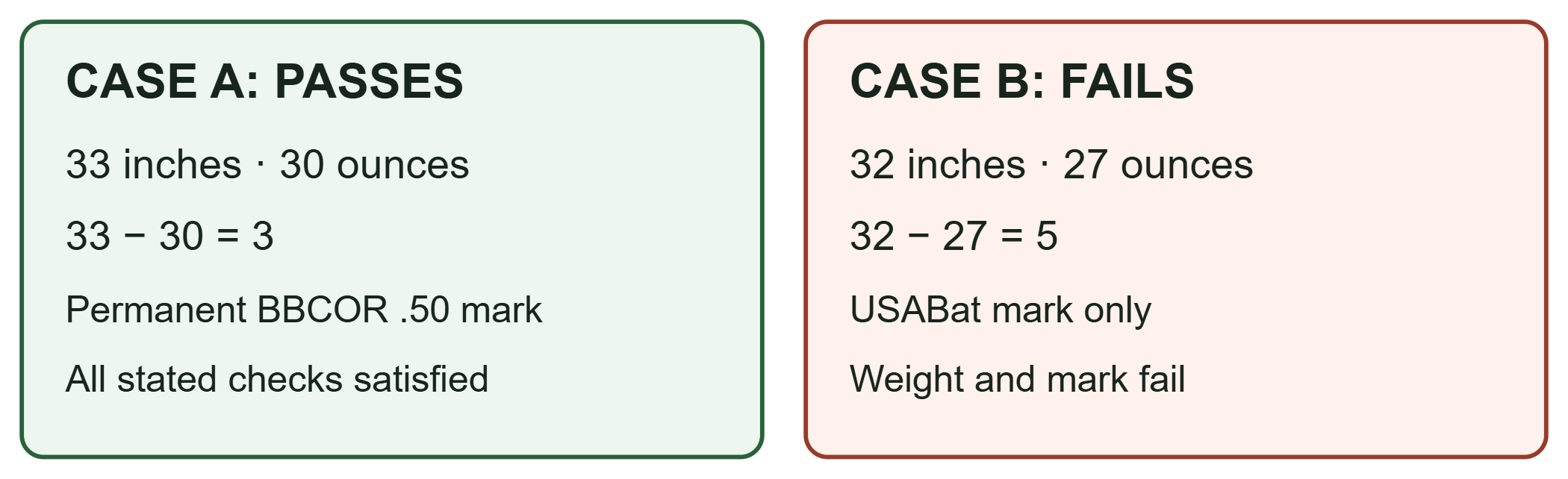
Case A: 33-inch, 30-ounce BBCOR bat
- Construction and measurements
- Nonwood; 33 inches long; 30 ounces; 2⅝-inch barrel diameter; 12-inch safety grip measured from the knob.
- Certification mark
- A contrasting, rectangular BBCOR .50 mark, 1 inch on each side, permanently silkscreened on the barrel.
- Condition
- Undamaged, with no disqualifying alteration.
- Model and event check
- In this fictional record, the examiner has verified the exact manufacturer, model identifier and 33-inch/30-ounce version against current manufacturer/model information, applicable certification and decertification lists, and relevant state instructions. No restriction disqualifies it for the hypothetical game.
- Calculation
- 33 − 30 = 3. The bat satisfies the weight requirement; its length, diameter and grip also fall within the stated limits.
- Result
- Passes the conditions shown. The result depends on all the listed checks, including current model eligibility.
Case B: 32-inch, 27-ounce USABat-only bat
- Construction and measurements
- Nonwood; 32 inches long; 27 ounces; 2⅝-inch barrel diameter; 12-inch safety grip measured from the knob.
- Certification mark
- USABat only; no permanent BBCOR .50 mark.
- Condition
- Undamaged.
- Calculation
- 32 − 27 = 5. A compliant 32-inch nonwood bat must weigh at least 29 ounces.
- Result
- Fails the 2026 NFHS check. It is too light for its length and lacks the required BBCOR mark. Its acceptable barrel diameter, grip and condition do not resolve either failure.
To reproduce either decision, follow the same sequence with the actual bat and current governing sources. These examples establish no real product’s eligibility.
Keep the 2028 changes separate from a 2026 decision
The NFHS Baseball Comments on the Rules—2027 describes bat-rule changes effective January 1, 2028. Those changes do not apply to 2026 games. Use the rules effective for the competition’s date, and verify individual models under those rules; the later comments do not guarantee approval of a particular future product.