
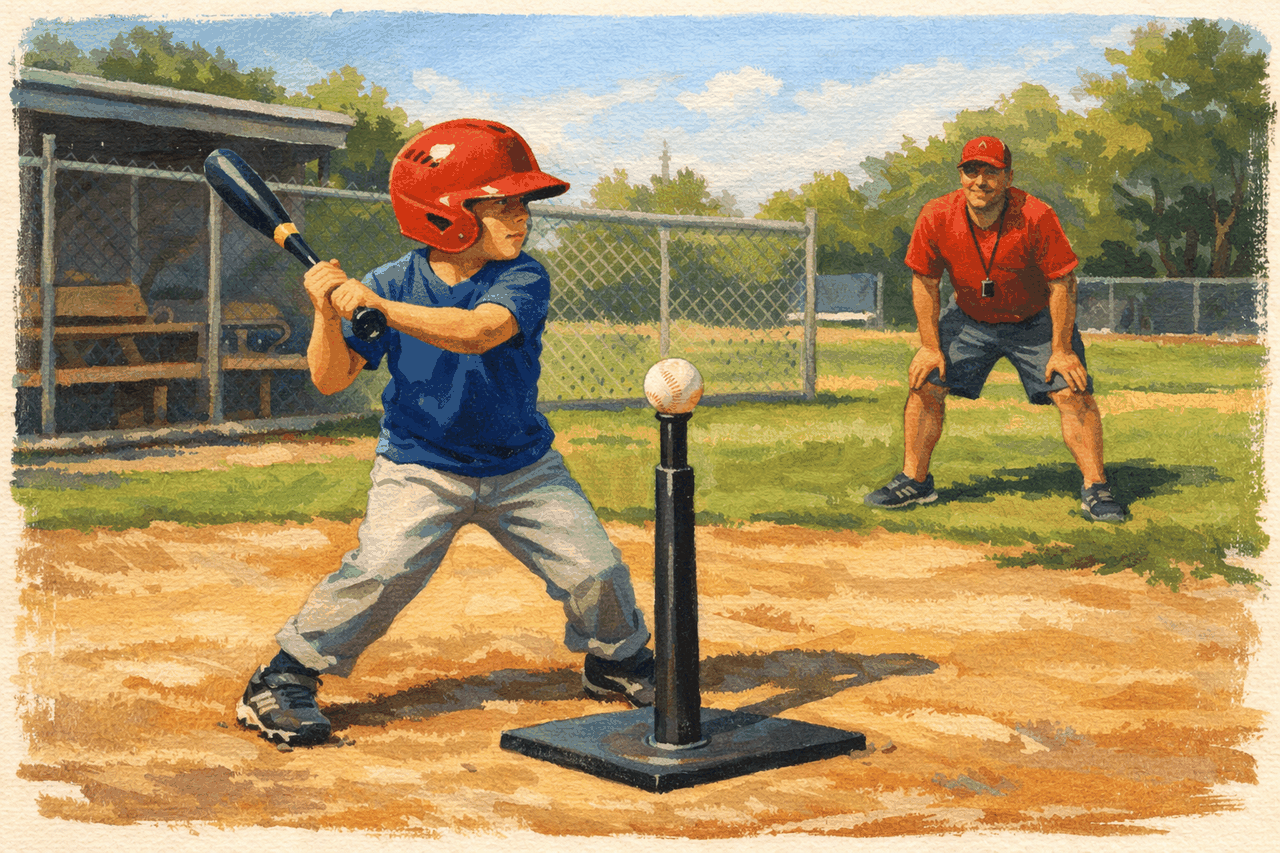
For the 2026 Little League Baseball regular season, finding your child’s division takes two steps: calculate their league age, then confirm which divisions your local league offers and which ages it accepts in each. Age ranges overlap, so a birthday alone does not determine placement.
Once you know the division, the game becomes easier to follow. Younger children may hit from a stationary tee. In Minors, the ball might come from a coach, a pitching machine, or another player. Later divisions change the field dimensions as well as the playing format.
Start with league age, then check local placement
For 2026 Little League Baseball, league age is the child’s age on August 31, 2026. A child born in September 2015 is league age 10; a child born in August 2015 is league age 11. Use the official 2026 Baseball Age Chart to match the birth month and year.
Next, ask your local league which divisions accept that league age. Tee Ball serves ages 4–7. By local option, some league-age 5- and 6-year-olds who have completed a year of Tee Ball may move into coach- or machine-pitch Minors. That possibility does not make the move automatic.
The Major Division, commonly called Majors, has an eligible age range of 9–12, subject to the ages the local league uses for its rosters. Intermediate (50/70) serves ages 11–13. An 11-year-old therefore falls within both published ranges, but the family still needs the local league’s placement decision. These ranges and local options are described on Little League’s Baseball Divisions page.
A useful registration question is: “My child is league age 10 for 2026. Which divisions accept that age here, how does pitching work in each, and how is placement decided?” That gets you closer to the actual game your child will play.
Compare the game your child will see
The comparison below brings the main differences together. Treat the age column as an eligibility guide, then confirm the local division’s arrangements before planning your season.
| Division | League ages | How the batter receives the ball | Field setup | Game length to plan around |
|---|---|---|---|---|
| Tee Ball | 4–7 | The batter hits a ball resting on a stationary tee. | Confirm the local Tee Ball layout. | Ask for the league’s introductory game schedule and any time limit. |
| Minors | Generally 5–11; entry for ages 5–6 depends on the local option and prior Tee Ball participation. | A coach, machine, or player pitches, depending on the local division. | Confirm the setup for the specific pitching division. | Six innings for player pitch under the standard schedule; check locally for coach pitch, machine pitch, and any time limit. |
| Majors | 9–12 eligibility; confirm locally accepted roster ages. | A player pitches. | 46-foot pitching distance and 60-foot base paths. | Normally six innings; a game-ending rule can shorten play. |
| Intermediate (50/70) | 11–13 | A player pitches. | 50-foot pitching distance and 70-foot base paths. | Normally seven innings; check any applicable local time option. |
Read the comparison this way: Tee Ball introduces hitting from a stationary ball; Minors introduces the league’s chosen pitching format; Majors uses player pitching on a 46/60 field. Intermediate moves the pitcher four feet farther from home plate and adds ten feet between bases. The overlapping ages mean these changes depend on division placement, not simply another birthday.
The age ranges, pitching formats, and Majors and Intermediate field dimensions come from Little League’s division descriptions.
Innings do not tell you an exact pickup time
An inning gives each team a turn at bat. Six innings describes the game’s structure, but it does not promise a particular number of minutes: some half-innings finish quickly, while others involve more batters and more plays.
Local scheduling arrangements and applicable time options also matter. Little League’s explanation of Regulation VII and regular-season schedules provides the scheduling framework. The adopted text of Regulation VII(c) gives a seven-inning standard for Intermediate and separate time-limit options for coach and machine pitch. Ask your league for the planned innings, whether a permitted time option applies, and what happens when that limit is reached. Get the schedule for the named division rather than carrying a younger team’s arrangements into the next age group.
A 10-run lead: when does the game end?
Consider this example specifically for 2026 Little League Major Division regular-season baseball. The visiting team bats first in each inning, called the top half. The home team bats second, in the bottom half.
- The top of the fourth ends: Visitors 12, Home 2. The visitors lead by 10 runs.
- The home team bats in the bottom of the fourth. The game does not end immediately when the visitors establish that lead.
- If the home team scores no runs: The fourth inning ends at 12–2, and the 10-run rule ends the game.
- If the home team scores two runs: The fourth inning ends at 12–4. The lead is eight, so the 10-run rule does not end the game at that point.
In kid-friendly terms: “They went first, so we still get our fourth turn to bat.”
The timing changes when the home team is ahead. If the visitors finish batting in the top of the fourth and the home team already leads by at least 10, the game can end after 3½ innings. The home team does not need another turn at bat to establish the required lead. Little League’s run-rule explanation sets out both the inning threshold and the home-team batting condition.
Keep this example attached to its stated division and regular-season setting. A different division or tournament needs its own applicable rules.
If the team is called “14U” or “travel”
Those labels alone do not identify a Little League division. Ask who organizes the competition, which named rulebook and season it uses, and what local modifications apply. Then confirm the age cutoff, pitching format, field dimensions, game length, and run rule under that ruleset.
For your child’s first game, the most useful information is specific: the confirmed division, who pitches, where the bases sit, and how the game can end.